Before the Web: The Walled Gardens of AOL, CompuServe, and Prodigy
Before social media, before the infinite scroll, and even before the ubiquitous "www" of the World Wide Web, getting "online" was a radically different experience. It wasn't a boundless, open universe; it was a curated, subscription-based theme park.
In the late 1980s and early 1990s, the digital frontier was dominated by "walled gardens"—all-in-one services that offered news, email, games, and shopping, all neatly packaged within their own proprietary software.
This was the era of the "Big Three": CompuServe, Prodigy, and America Online (AOL). They weren't the internet as we know it, but for millions of people, they were the "training wheels" that brought the concept of a connected world into the home.
*The True Precursors: ARPANET and the BBS*
To understand the walled gardens, you must first know what existed before them. The online world evolved on two separate tracks: a government-funded academic network and a decentralized, grassroots hobbyist scene.
- The Technical Foundation: ARPANET The direct ancestor of today's internet was the ARPANET (Advanced Research Projects Agency Network). Launched in 1969 by the U.S. Department of Defense, this was not a public service. It was a resilient, decentralized network designed to connect researchers at universities and government labs. Its purpose was to survive a potential nuclear attack—if one node was destroyed, data could simply find another path. ARPANET pioneered the two technologies that make the modern internet work:
- *Packet Switching: *Breaking data (like an email) into small "packets" that are sent separately and reassembled at the destination.
- TCP/IP (Transmission Control Protocol/Internet Protocol):* The universal "language" that allows different types of computers and networks to communicate with each other. It was formally adopted in 1983, an event many consider the true "birth" of the Internet.
- The Cultural Foundation: The BBS While ARPANET was for academics, the average computer enthusiast was logging onto *BBSs (Bulletin Board Systems)**. The first public BBS (CBBS) was launched in Chicago in 1978. A BBS was a single computer, often run by a hobbyist (called a "Sysop") in their basement, connected to a single phone line. Users would dial the BBS's phone number with their modem. If the line was busy, you had to wait. Once connected, you entered a text-only world where you could post messages on forums, download "shareware" files (like the original Doom or PKZIP), and play simple text-based games. Because long-distance calls were expensive, BBSs were hyper-local, creating thousands of small, independent digital communities.
*The Rise of the Walled Gardens*
The "Big Three" services saw a business opportunity. Why make users dial thousands of different BBSs when you could offer all the best features—email, forums, news, and games—in one user-friendly, flat-rate package?
*CompuServe: The Old Guard***
The first major player was CompuServe. Starting in the late 1970s, it was the dominant force of the 1980s. It was largely text-based, navigated with commands, and was seen as a serious, technical service. It was famous for its in-depth forums (called FOORUMS) and its massive file-sharing libraries, attracting a clientele of professionals and dedicated tech enthusiasts. It was powerful but expensive and intimidating for a novice.
*Prodigy: The Graphical Pioneer***
Launched in 1988 as a joint venture between IBM, CBS, and Sears, Prodigy's innovation was clear: it was graphical from the start.* While CompuServe users were typing commands, Prodigy users were clicking on colorful, (very) slow-loading images.
- What it offered:* Prodigy was built for the mainstream family. You could check news and weather, bank online, and—crucially for its co-founder—shop for items from the Sears catalog.
- Its Downfall:* Prodigy was slow, as its graphics had to be transmitted over sluggish dial-up modems. It was also heavily curated. The company famously censored user messages and forums, which clashed with the free-wheeling culture growing on the wider internet. In 1994, it became the first of the Big Three to offer a gateway to the new World Wide Web, but its core "all-in-one" service was already losing its appeal.
*AOL: The King of Accessibility***
America Online, which began as Quantum Link in 1985 for Commodore 64 computers, learned from its competitors' mistakes. When it launched as AOL in 1989, it had one focus: make it easy.*
AOL’s interface was friendly, colorful, and simple. Users were welcomed by a "lobby" and could easily find their way to the platform's main attractions:
- Chat Rooms:* AOL democratized real-time chat. Rooms based on any topic imaginable (and many that were unimaginable) were the main draw, creating a massive, vibrant social scene.
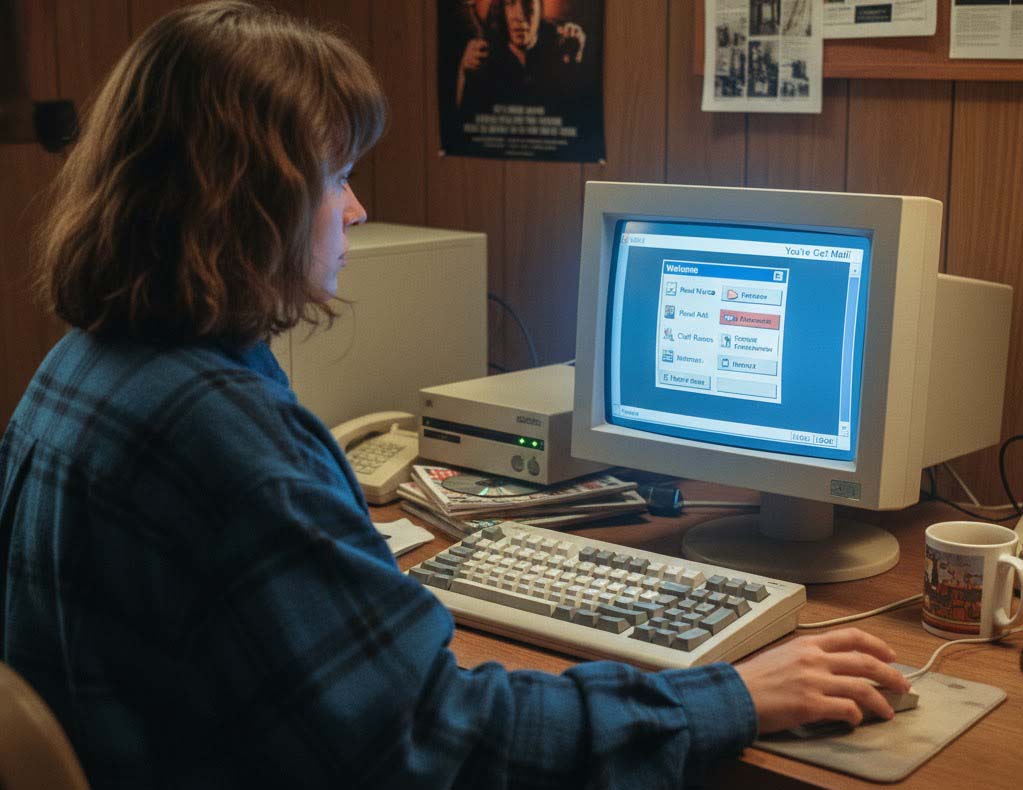
- "You've Got Mail!": This iconic soundbite made email an exciting, mainstream event.
- Relentless Marketing:* AOL's strategy was to be everywhere. It mass-produced floppy disks and, later, CDs with its free trial software. At one point in the mid-90s, it was estimated that half of all CDs being manufactured in the world had an AOL logo on them.
It's impossible to overstate the sheer ubiquity of AOL CDs in the 1990s. They were an inescapable artifact of the pre-broadband era, a relentless marketing blitz that felt like a force of nature. You couldn't check your mail without one sliding out of a new catalog. You couldn't buy a computer magazine (or, really, any magazine) without one, or sometimes two, falling into your lap. They were shrink-wrapped to new computer boxes, handed out at Kmart checkouts, and stacked like coasters at electronics stores. Promising 100, 500, or even 1000 free hours, these discs were the primary vector for getting America online, turning into a form of high-tech junk mail that, for millions, served as their very first gateway to the digital world.
This strategy worked. AOL brought millions of non-technical people online, rocketing past Prodigy and CompuServe (which it eventually acquired) to become the undisputed king of the 1990s online world.
*The Garden Wall Comes Tumbling Down*
The "walled garden" model was doomed by the very thing it tried to contain. In 1991, Tim Berners-Lee launched the World Wide Web, a system for sharing information over the internet using a browser.
At first, AOL and Prodigy saw the "Web" as just another feature, like "weather" or "shopping." They built "browsers" into their software that allowed you to access this new, strange place.
But users quickly realized the truth: the open, uncensored, and infinitely vast World Wide Web was the destination. The curated content inside AOL's walls was a tiny pond next to a boundless ocean.
By the late 1990s, the business model for AOL and Prodigy had to pivot. Their value was no longer in their content but in their connection. They transformed from being all-in-one destinations into "Internet Service Providers" (ISPs)—the "on-ramp" to the real internet. Their walls, once their greatest asset, had become their prison.
While ARPANET built the highway and BBSs were the first local hangouts, it was Prodigy and AOL that built the easy-to-drive cars, complete with maps and a friendly dashboard, that convinced an entire generation to finally take a drive.
Comments (0)
No comments yet. Be the first to share your thoughts.
Sign in in your browser to leave a comment.