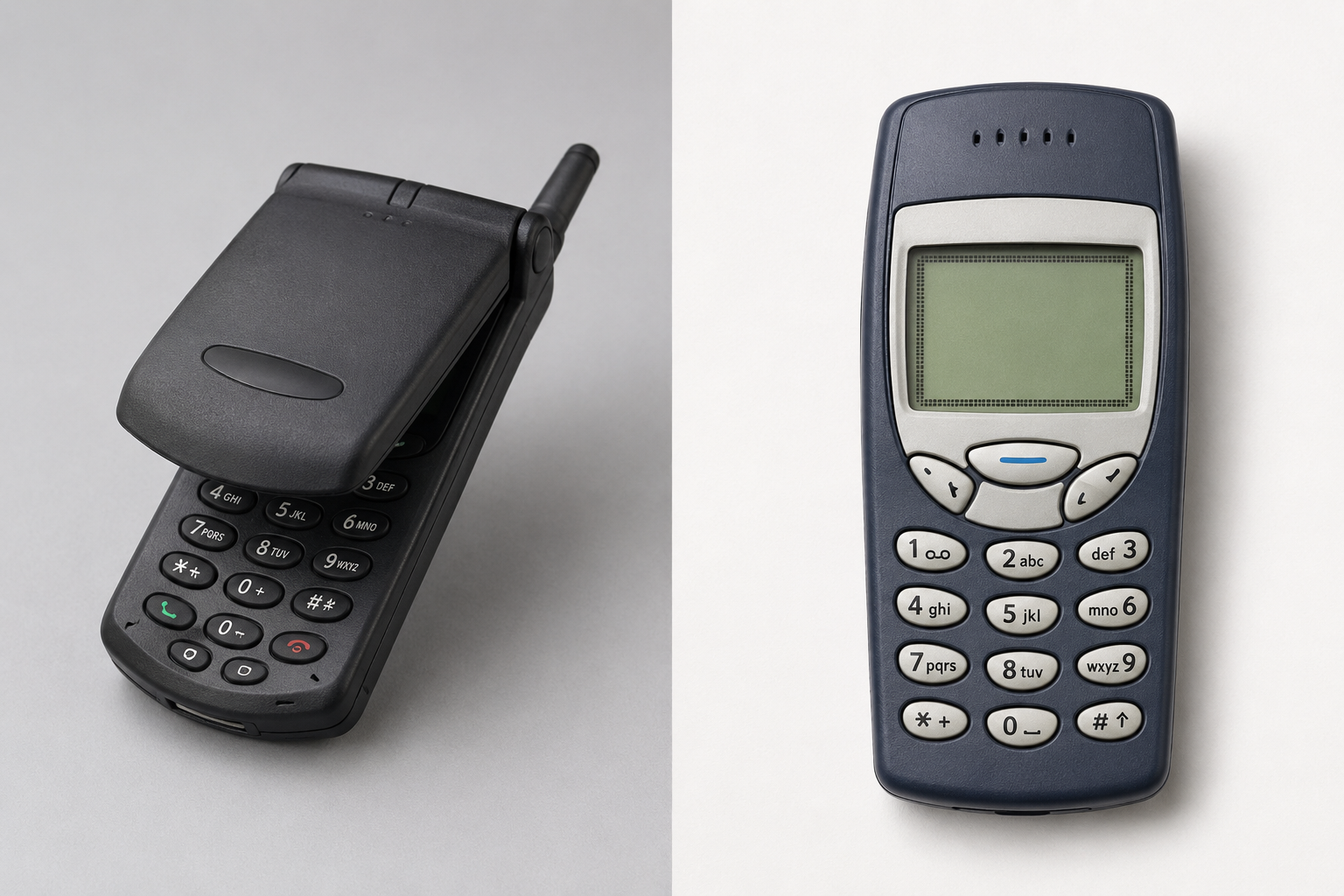
How the Motorola StarTAC and Nokia 5110 Sparked the 1990s Mobile Revolution
At the dawn of the 1990s, the mobile telephone was a rare, cumbersome tool restricted to corporate boardrooms and Hollywood elites. Wrapped in heavy briefcases or permanently bolted to automobile dashboards, early cellular tech was defined by its weight, its prohibitive cost, and its stark lack of consumer appeal. However, within a span of just four years, a radical design shift completely altered the cultural landscape, transforming the wireless phone from an expensive novelty into an extension of the human hand.
This democratization of communication did not happen by accident. It was forged by two distinct hardware paradigms that split the decade into halves. First came the era of elite miniaturization, which proved that technology could be incredibly beautiful and hyper-portable. Following immediately behind was the era of mass accessibility, which realized that software, customizability, and pure durability could capture the imagination of the everyday global citizen. Together, these movements established the foundation of modern hyper-connectivity.
1996: The Clamshell Catalyst
By the mid-1990s, manufacturers had successfully shrunk the "brick" phones of the 1980s into slightly more manageable sizes, but devices remained uninspired blocks of industrial plastic. That trajectory changed permanently in January 1996 when Motorola unveiled the StarTAC. Inspired heavily by the futuristic communicators of Star Trek, the StarTAC was a profound engineering achievement: the world's very first true "clamshell" flip phone.
Weighing a mere 3.1 ounces, the StarTAC completely reimagined how a phone occupied physical space. Instead of forcing users to adapt to the phone, the device folded neatly in half to adapt to the user. It could comfortably clip to a waistband or slip cleanly into a shirt pocket without dragging down the fabric. For the first time, a mobile phone felt genuinely wearable.
> Design Profile: Motorola StarTAC (1996)*
> "The StarTAC wasn't just a phone; it was a physical performance. Pulling out the slim antenna and snapping open the mechanical flip with a single flick of the wrist became the ultimate corporate power move of the late nineties."
However, the StarTAC remained heavily exclusionary. With an initial retail price hovering around $1,000, it was explicitly targeted at high-earning professionals, politicians, and celebrities. It succeeded wildly in shifting public perception—making cell phones look undeniably cool, sleek, and desirable—but it did not solve the equation of mass market accessibility. The world was primed for a device that could bring that same sense of wireless freedom to the middle class.
1998: The Mass Market Phenomenon
That paradigm shift arrived in 1998 from an unexpected powerhouse in Finland. Nokia understood that if mobile phones were going to truly take off, they needed to transition from sterile business tools into dynamic consumer products. Their answer was the Nokia 5110, an uncompromisingly robust, candy-bar-shaped handset that would become the true inflection point for the global cellular boom.
The 5110 discarded the elitist marketing of its predecessors and targeted a completely untouched demographic: the general consumer, including teenagers and young adults. It achieved this by pioneering three key features that transformed consumer tech into a highly personal canvas:
- Xpress-on Covers:* Nokia realized that phones didn't have to be monochromatic blocks. By introducing interchangeable front plates in vivid shades of red, blue, yellow, and green, they transformed a gadget into an expression of personal identity and fashion.
- The Navi-Key Interface:* Before the 5110, navigating phone menus required studying a manual. Nokia's genius layout utilized a single, large context-sensitive button that made sending text messages (SMS) incredibly intuitive for anyone.
Crucially, the 5110 also introduced a piece of software that would define a generation of mobile culture: Snake. This simple, monochrome puzzle game gave millions of people a compelling reason to interact with their phone even when they weren't actively making a call or sending a text message, subtly foreshadowing the app-driven ecosystem of the future.
> Design Profile: Nokia 5110 (1998)*
> "Where Motorola built a luxury sports car, Nokia built an indestructible tank for the masses. It was a phone designed to survive life's accidents while keeping you endlessly entertained."
The Legacy of the Mobile Boom
The numbers behind the late-90s cell phone explosion speak for themselves. Powered by the accessibility of the 5110 (and its direct evolutionary successor, the iconic Nokia 3310 in 2000), wireless subscription rates went from a niche single-digit percentage of the population to an absolute majority by the turn of the millennium.
Looking back, the Motorola StarTAC and the Nokia 5110 represent the two vital, complementary halves of the mobile revolution. Motorola proved that a telephone could be a marvel of miniature design and a deeply coveted object of desire. Nokia took that desire, stripped away the luxury price tag, added intuitive software, and proved that a phone could be a rugged, fun, and personalized companion for everyday life.
By the time the 1990s came to a close, the public payphone was well on its way to obsolescence, the social fabric had been permanently rewired by the birth of texting culture, and humanity had taken its first irreversible steps into a world where anyone, anywhere, was only a few button presses away.
Comments (0)
No comments yet. Be the first to share your thoughts.
Sign in in your browser to leave a comment.