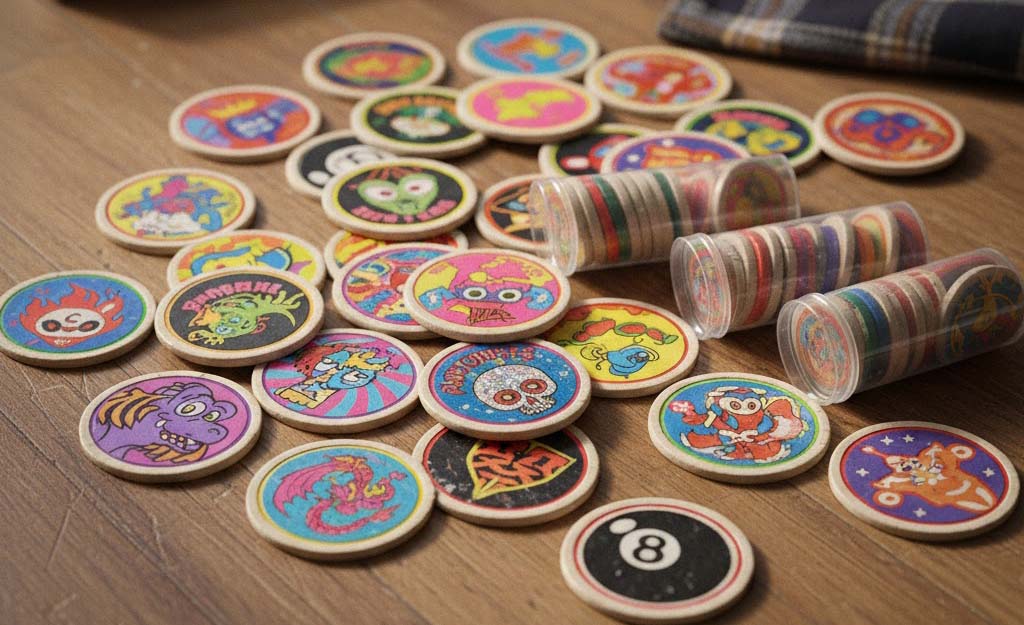
Slammed: The Rise and Fall of POGs, the 90s Playground Obsession
For a few frantic years in the mid-1990s, playgrounds, school buses, and bedrooms weren't ruled by video games or smartphones, but by small, circular pieces of cardboard. This was the era of POGs, a collectible craze that swept the globe, creating a multi-million dollar industry from what was essentially a souped-up version of a game played with milk bottle caps.
If you were a kid during this time, the thwack of a "slammer" hitting a stack of POGs was the soundtrack to recess. If you weren't, the entire phenomenon was likely a baffling, noisy blur. This is the story of how a simple Hawaiian game became a worldwide fad.
*What Were POGs and How Did You Play?**
The game itself was simple, which was a huge part of its appeal.
- The Pieces:* The game required two types of discs.
- POGs (or Milk Caps):* Small, flat, circular cardboard discs. These were the main currency. They came in thousands of different designs, featuring everything from cartoons and superheroes to brand logos and holographic skulls.
- Slammers:* Heavier, thicker discs, often made of plastic, metal, or rubber. These were the "shooters" used to play the game.
- The Rules:*
- Each player would contribute an equal number of POGs to a central stack, which was placed face-down.
- Players took turns throwing their slammer down onto the stack.
- Any POGs that flipped over to land face-up were collected and kept by that player.
- The remaining face-down POGs were re-stacked, and the next player took their turn.
- The game continued until the stack was gone.
The most controversial and thrilling part of the game was the common rule of "playing for keeps." What you won, you kept. This simple rule turned a casual game into a high-stakes battle for playground supremacy, where a single good throw could win you a dozen new POGs, including your best friend's prized holographic dragon.
*The Hawaiian Origins: From Juice to Craze*
The game of POGs didn't actually start in the 1990s. Its roots trace back to the 1920s and 1930s in Hawaii, where children played a game with milk bottle caps, likely an evolution of the traditional Japanese game of Menko.
The fad, and the name, lay dormant for decades until the 1970s, when a Hawaiian fruit juice brand—the Haleakala Dairy on Maui—began selling a new drink. It was a blend of P*assionfruit, O*range, and G*uava, and its bottle caps were stamped with the "POG" logo.
The game's modern explosion can be credited to one person: Blossom Galbiso, a teacher in Oahu, Hawaii. In 1991, she introduced the old milk cap game to her students, using the POG juice caps she had saved. The game was an instant hit with her class, and it quickly spread across the islands.
A savvy entrepreneur saw the potential, licensed the "POG" brand, and began marketing the game on the mainland. The World POG Federation was formed, and by 1994, the fad had exploded. POGs were no longer just juice caps; they were a full-blown collectible, produced by countless companies and featuring every design imaginable to appeal to kids.
*The Fad's Peak and the "Gambling" Controversy*
At its zenith around 1994-1995, POG-mania was unstoppable. Kids carried their collections in special POG tubes and binders. Toy stores had entire aisles dedicated to them. Designs ranged from The Simpsons and Power Rangers to sports teams, aliens, and the iconic 8-ball.
But the "playing for keeps" aspect soon caused a moral panic. Parents and educators grew concerned that the game was, in effect, a form of gambling for children. Fights broke out over lost POGs, and the game became a major distraction in classrooms.
This led to the fad's first major obstacle: school bans. All across the country, principals outlawed POGs, relegating the game to underground recess sessions and sleepovers. This ban, combined with inevitable market saturation (there were simply too many POGs being produced), signaled the beginning of the end.
*The Inevitable Decline*
Like all intense fads, the POG craze burned out as quickly as it had ignited. By 1998, the phenomenon was essentially over. Kids had moved on to the next big things, like Beanie Babies, Pokémon cards, and the Nintendo 64. The slammer's thwack was replaced by the digital sounds of a new era.
Today, POGs are a potent symbol of 1990s nostalgia. They represent a time when a simple, tactile game could capture the world's attention, turning worthless bits of cardboard into treasured possessions, all before the internet took over the playground. treasured possessions, all before the internet took over the playground.
Comments (0)
No comments yet. Be the first to share your thoughts.
Sign in in your browser to leave a comment.