The Blue and Yellow Behemoth: How Blockbuster Won the 90s
In the 1990s, before "binge-watching" meant eight hours on a sofa with a streaming service, the Friday night ritual was an event. It involved a trip, a hunt, and a negotiation, all under the bright fluorescent lights of a store with a towering blue-and-yellow ticket sign. Blockbuster Video didn't just rent movies; it dominated the weekend. Its rise from a single shop to a global empire of over 9,000 stores is a story of perfect timing, aggressive strategy, and a brilliant understanding of the American family.
*The Origin: A Better Video Store*
The story begins not with a movie mogul, but with a software entrepreneur. David Cook, who specialized in software for Texas oil and gas companies, saw the video rental landscape of the early 1980s and identified a problem. The industry was a fragmented collection of small, often dingy, mom-and-pop shops with limited selection, poor tracking, and a back room filled with adult films.
Cook's idea was revolutionary in its simplicity: what if a video store could be run like a modern supermarket?
On October 19, 1985, he opened the first Blockbuster Video in Dallas, Texas. It was a stark contrast to its competitors:
- Massive Inventory:* The first store boasted 8,000 VHS and 2,000 Beta tapes, dwarfing the few hundred titles at rival shops.
- Computerized System:* Using his software background, Cook built a computerized inventory and checkout system. This sped up lines and provided valuable data on what titles were popular.
- Family-Friendly: From day one, Blockbuster had a strict "no pornography" policy. This wasn't just a moral stance; it was a core business strategy. It eliminated zoning hurdles and instantly branded Blockbuster as a safe, clean, and welcoming place for families and children.
*The Expansion: "Wayne's World"**
Cook's model was a success, but it was the arrival of a new investor that turned Blockbuster into a juggernaut. In 1987, Wayne Huizenga, a co-founder of Waste Management, led a group to invest in the 19-store chain.
Huizenga applied the same aggressive, scalable model he had used in the garbage business to video rentals. His philosophy was simple: total saturation.
Under Huizenga's leadership, Blockbuster's growth was explosive.
- Rapid Acquisition:* Huizenga bought out major regional competitors, including Erol's and Major Video, absorbing hundreds of stores at a time.
- Breakneck Speed:* The company began opening new stores at an astonishing rate. At its peak, a new Blockbuster store was opening every 17 hours.
- Prime Real Estate:* Stores were strategically placed in highly visible, easily accessible strip malls, becoming an unmissable part of the American suburban landscape.
By the early 1990s, Blockbuster had become the undisputed king of home video, steamrolling thousands of independent stores in its wake.
*The Ubiquity: "Make it a Blockbuster Night"**
Blockbuster's dominance in the 1990s wasn't just due to its number of stores; it was about embedding itself in the culture.
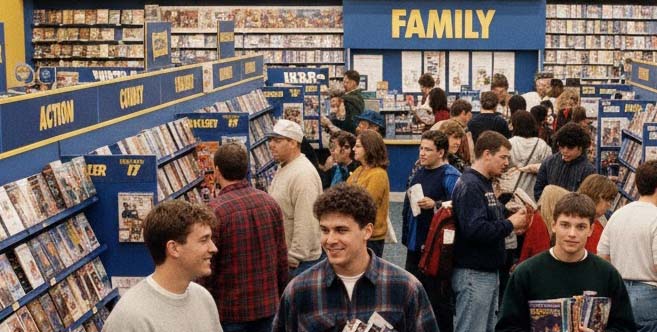
The In-Store Experience Walking into a Blockbuster was an experience. The bright lights, the smell of popcorn and plastic VHS cases, and the iconic, color-coded genre aisles (Comedy, Action, Drama, and the sacred "New Releases" wall) turned browsing into a treasure hunt. The "Family" section was prominently featured, reinforcing its core brand.
Marketing Genius The company's marketing was pitch-perfect. The slogan "Make it a Blockbuster Night" transformed a simple rental into a planned family event. It positioned Blockbuster as the source of weekend entertainment and family bonding.
Media Integration In 1994, media giant Viacom (owner of MTV, Nickelodeon, and Paramount Pictures) acquired Blockbuster for $8.4 billion. This move was intended to create a vertically integrated entertainment powerhouse, with Blockbuster serving as the primary distribution channel for Viacom's films.
Solving the Biggest Problem In the late 90s, Blockbuster rolled out its most potent weapon: revenue sharing. The biggest customer complaint had always been showing up on a Friday only to find every copy of a new hit (like Titanic or Men in Black) was already rented.
With revenue sharing, studios provided tapes to Blockbuster at a massive discount (sometimes just a few dollars) in exchange for a 40% cut of the rental revenue. This allowed Blockbuster to stock its shelves with hundreds of copies of new releases, confidently advertising "guaranteed availability" and eliminating its single greatest weakness.
For a time, Blockbuster was more than a store. It was the gatekeeper of Hollywood, the facilitator of first dates, the savior of rainy days, and the non-negotiable first stop for a "Blockbuster Night."
Comments (0)
No comments yet. Be the first to share your thoughts.
Sign in in your browser to leave a comment.