The Cartridge Killer : How PlayStation's CD-ROM Won the 90s Console War Against Nintendo
The story of how Sony overthrew Nintendo in the 1990s is one of corporate betrayal, massive technological shifts, and a fundamental misunderstanding of what a new generation of gamers actually wanted.
At the dawn of the 1990s, Nintendo was the absolute king of video games. The Nintendo Entertainment System (NES) had single-handedly saved the North American gaming industry in the 80s, and the Super Nintendo (SNES) was winning a fierce 16-bit war against Sega. Sony, meanwhile, didn’t even make video games. They made TVs, walkmans, and audio chips.
By 1999, the landscape had completely flipped. Sony's newcomer console, the PlayStation, had become a global culture juggernaut, on its way to selling over 102 million units. Nintendo's competitor, the Nintendo 64, managed just 33 million.
Here is exactly how the ultimate corporate underdog pulled off the biggest coup in tech history.
The Greatest Betrayal in Gaming History
The irony of the PlayStation is that Nintendo actually created it.*
In the late 1980s, Nintendo recognized that CD-ROM technology was the future. They partnered with tech giant Sony—specifically an ambitious engineer named Ken Kutaragi—to create a CD-ROM drive add-on for the upcoming SNES.
However, in 1991, Nintendo's president, Hiroshi Yamauchi, read the fine print of the contract. He realized it essentially gave Sony total control over all games written on the new CD format and a massive chunk of the software royalties. Infuriated, Yamauchi decided to backstab Sony in the most public way possible.
At the 1991 Consumer Electronics Show (CES), Sony proudly announced their joint venture with Nintendo. The very next morning, Nintendo took the stage and shocking everyone, announced they were ditching Sony to work with their direct rival, Philips.
Sony executives were humiliated. But instead of slinking away, an incensed Sony leadership gave Ken Kutaragi the green light to take their hardware designs and build an independent, standalone console. The project was fueled by pure corporate revenge.
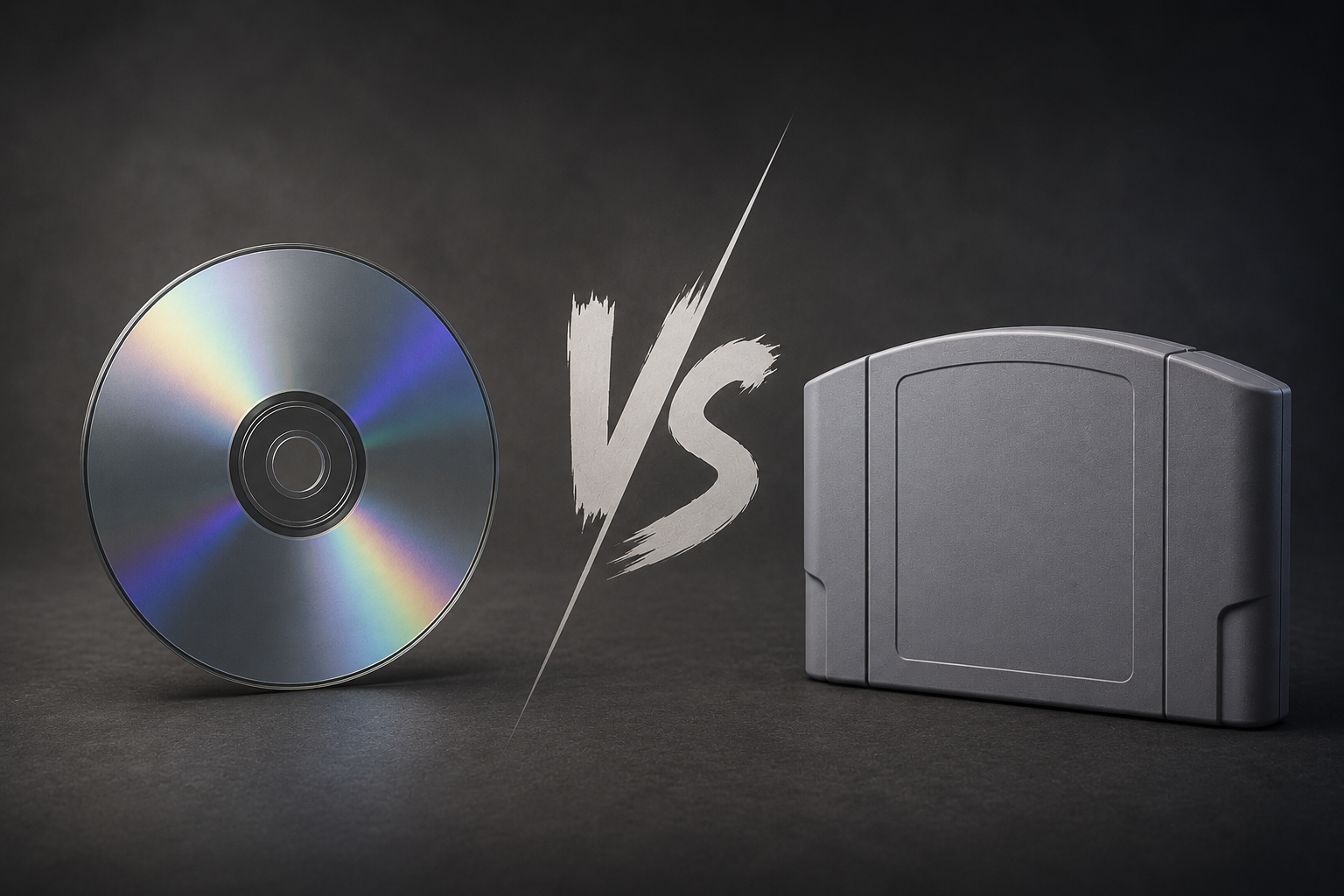
Plastic Cartridges vs. Shiny Discs
When it came time for the next generation of consoles in the mid-90s, Sony and Nintendo made two completely different bets on storage technology. It was the deciding factor of the war. Sony built the PlayStation around CD-ROMs. Nintendo, terrified of software piracy and wanting to maintain strict manufacturing control, chose to stick with traditional silicon cartridges for the Nintendo 64.
This choice crippled Nintendo in two ways: storage capacity and manufacturing cost. CD-ROMs, which offered a massive 700 MB of storage capacity, cost mere pennies to press, allowed games to retail at a more affordable 40 to 50 dollars, and took only days to print when restocking store shelves. In stark contrast, Nintendo's proprietary silicon cartridges were severely limited to between 4 MB and 64 MB of storage, cost a hefty 15 to 30 dollars just to manufacture, drove retail game prices up to a steep 60 to 80 dollars, and required weeks or even months of factory production time to replenish stock.
Because N64 cartridges had less than 10% of the storage capacity of a PlayStation disc, multi-hour cinematic games with fully orchestrated music, voice acting, and pre-rendered cutscenes were functionally impossible on Nintendo's machine.
Furthermore, because cartridges were so expensive to produce, game developers had to take massive financial risks. If a game flopped, the publisher was stuck with millions of dollars of unsold plastic and silicon. With Sony, if a game sold out, they could press new CDs and have them on store shelves in days.
The Great Developer Exodus
Because of the cartridge issue, third-party developers abandoned Nintendo in droves.
The biggest blow came from Square (now Square Enix). Square had been fiercely loyal to Nintendo, creating all their legendary Final Fantasy role-playing games for the NES and SNES. But their vision for Final Fantasy VII required massive 3D worlds and cinematic cutscenes that simply could not fit onto an N64 cartridge.
Square jumped ship to Sony. When Final Fantasy VII launched exclusively on the PlayStation in 1997, it became a global phenomenon, moving millions of consoles entirely on its own. Other massive franchises like Resident Evil, Tomb Raider, and Metal Gear Solid followed suit, making the PlayStation the undisputed home for the industry's most innovative games.
Growing Up: Marketing to a New Generation
Nintendo had spent a decade positioning video games as a wholesome, family-friendly hobby for kids. Sony saw an opportunity to market to an entirely different demographic: teenagers and twenty-somethings.*
Sony launched the PlayStation with edgy, counter-culture advertising. They put console kiosks in nightclubs, targeted college campuses, and leaned into music-heavy, stylized games like Wipeout (which featured a licensed electronic soundtrack from artists like The Chemical Brothers).
Suddenly, playing Nintendo felt childish. Playing PlayStation felt cool, mature, and cutting-edge. Sony managed to transition video games from a toy room staple into a legitimate piece of pop-culture entertainment.
> The $100 Mic Drop
> At E3 1995, Sega took the stage and announced their new Saturn console would launch immediately for $399. Next up was Sony. Sony executive Steve Race walked up to the podium, muttered a single number into the microphone—"Two ninety-nine"—and walked off. The $100 price difference instantly killed Sega's momentum and put Nintendo on notice before the PlayStation even launched in the West.
The Aftermath
By the turn of the millennium, the PlayStation had crossed the 100-million-unit threshold, a feat never achieved by a home console before.
Nintendo didn't die—their first-party masterpieces like Super Mario 64 and The Legend of Zelda: Ocarina of Time kept the N64 afloat and redefined 3D game design forever. But their absolute monopoly over the living room was gone. Sony’s rise forced Nintendo to eventually abandon direct hardware arms races altogether, leading them to pivot toward unique hardware concepts like the Wii and the Switch later on.
Sony's calculated revenge didn't just break Nintendo's crown; it rewrote the rules of the entire video game industry.
Comments (0)
No comments yet. Be the first to share your thoughts.
Sign in in your browser to leave a comment.