The Furbish Phenomenon: How a Talking Robot Gremlin Conquered the 1990s
If you were a parent, or even just sentient, during the Christmas season of 1998, you likely remember the chaos. It was a time of long lines, frantic store searches, and even reports of parents physically fighting in toy aisles. The cause of this madness? A furry, owl-like, gibberish-spouting robot named Furby.
The Furby wasn't just a toy; it was a cultural event, a full-blown mania that defined the late '90s "it" toy craze. Launched by Tiger Electronics in October 1998, Furbies sold an astonishing 1.8 million units in their first holiday season alone. By 2000, over 40 million had been sold worldwide.
But why? What made this $35 animatronic creature so compelling that it commanded $300+ resale prices on the nascent website eBay? It was a perfect storm of novel technology, smart marketing, and a touch of urban legend.
*It Felt "Alive"**
Before Furby, mainstream toys were largely passive. Dolls were dolls, and action figures were static plastic. The biggest tech craze before it was the Tamagotchi, a digital pet you had to keep alive on a keychain. Furby took the "nurturing" appeal of a Tamagotchi and put it into a physical, pettable body.
- Radical Interactivity:* Furbies were packed with sensors. They had a light sensor on their forehead (for "petting"), a microphone (to react to sound), a tilt sensor (to know if you were holding it), and a sensor in its "mouth" (to "feed" it).
- Physical Response:* It didn't just beep. It blinked its big, animatronic eyes. It wiggled its ears. It opened and closed its beak. It shivered, cooed, and seemed to react directly to its owner. For a '90s kid, this was indistinguishable from magic.
*The "Learning" English Illusion*
The single most brilliant mechanic of the Furby was its language. Out of the box, a Furby spoke only "Furbish," a simplistic, caveman-like language ("Kah-tay-loo" for "How are you?," "Wee-tah-kah-loo-loo" for "Tell me a joke").
The toy was programmed to gradually "learn" English (or whatever language it was sold in). Over time, it would phase out Furbish words and replace them with pre-programmed English phrases.
This wasn't true AI—it was just a clever timer-based system. But to a child (and many adults), it created a powerful illusion. The child felt they were personally teaching their pet to talk. This forged a deep emotional bond and a sense of responsibility that simple dolls couldn't replicate.
*The Social Network (of Toys)**
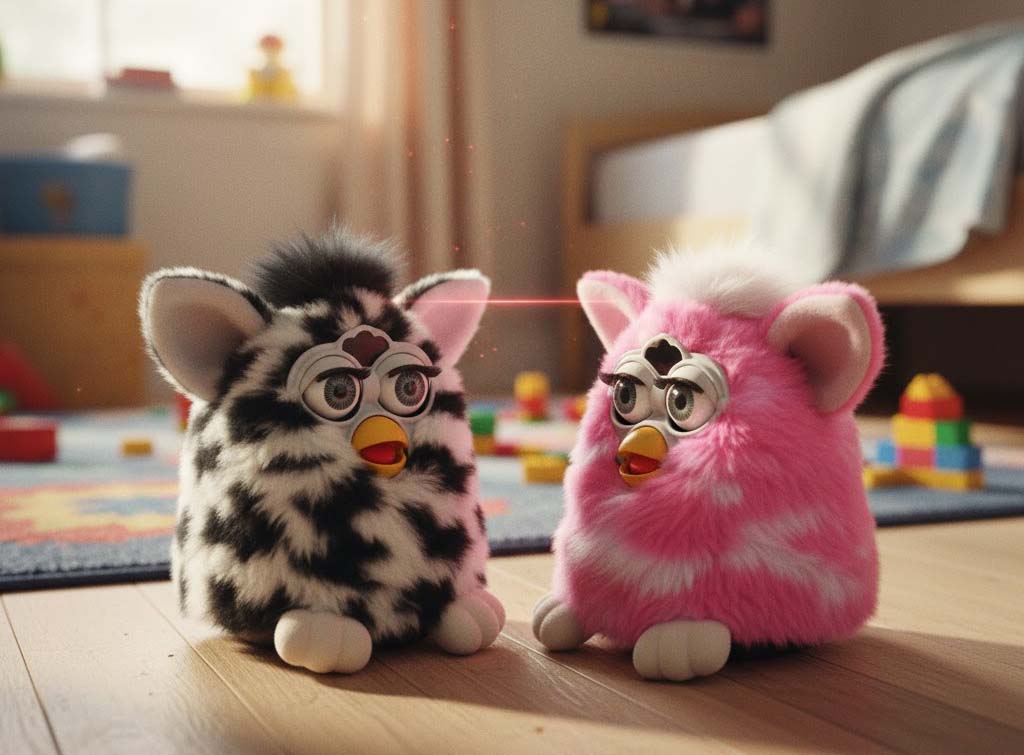
This was the feature that truly set Furby apart and drove the "collect-them-all" mentality. Furbies were equipped with an infrared (IR) sensor between their eyes.
When you put two Furbies in a room, they would "see" each other and strike up a conversation.
They would chat in Furbish, tell jokes, sing songs, and even "catch a cold" from one another. This was a revolutionary concept for a toy. It wasn't just one toy; it was a social platform. It strongly encouraged kids to buy more Furbies (or beg their friends to bring theirs over) just to see what they would do together.
*Manufacturing a Frenzy*
Tiger Electronics masterfully stoked the flames of demand.
- Calculated Scarcity:* The initial launch was limited. Whether this was an intentional marketing ploy or a genuine underestimation of demand, it worked. The toys were immediately impossible to find.
- Media Hype:* The media loves a "hot toy" story. Local and national news ran constant segments on the "Furby Frenzy," showing footage of desperate parents lining up at dawn outside Toys "R" Us. This free press fueled a feedback loop: the more the media reported on the scarcity, the more people wanted one.
- The Resale Boom:* The 1998 holiday season coincided with the rise of eBay. Furbies became one of the first products to demonstrate the power of the online resale market. Seeing a $35 toy sell for hundreds of dollars only added to its mythical status.
*A National Security Threat?**
In a bizarre but true epilogue, the Furby's legend was cemented by an unlikely source: the *National Security Agency (NSA)**.
In 1999, the NSA banned Furbies from its offices. The "Reasoning" page of their internal newsletter claimed that toys "with internal recording capabilities are prohibited." They were worried that a Furby might "learn" and repeat classified information. This was, of course, false. Furbies had no recording capability whatsoever; they only reacted to sound and spoke pre-programmed phrases. But the story went viral, adding to the Furby's mystique as a piece of unbelievably advanced (and slightly spooky) technology.
In the end, the Furby wasn't just a toy. It was a technological pioneer, a marketing case study, and a cultural touchstone that perfectly captured the pre-millennium blend of technological optimism and consumerist mania.
Comments (0)
No comments yet. Be the first to share your thoughts.
Sign in in your browser to leave a comment.