
The Great Beanie Baby Bubble: How a $5 Toy Ignited a $1 Billion Mania
In the mid-1990s, a cultural and economic phenomenon swept the globe, centered not on stocks or real estate, but on small, pellet-filled stuffed animals. Beanie Babies, the $5 plush toys created by the enigmatic Ty Warner, became the obsession of millions, transforming from children's playthings into one of history's most fascinating and bizarre speculative bubbles. It was a craze that had adults fighting in stores, families investing their life savings, and a divorced couple dividing their collection on a courtroom floor.
This is the story of how a brilliant marketing strategy, a new technology called the internet, and a wave of collective delusion created a billion-dollar frenzy.
The Architect of Scarcity
The story begins in 1993 with H. Ty Warner, a reclusive toy salesman who founded Ty Inc. His idea was simple: create a line of small, affordable plush toys. But Warner's genius wasn't just in the design; it was in the distribution.
Unlike other toy giants who flooded the market through big-box retailers like Toys "R" Us and Walmart, Warner employed a strategy of artificial scarcity.
- Limited Supply:* Beanie Babies were sold only in small, independent gift and specialty shops.
- Restricted Shipments:* Stores were often limited to ordering just 36 of any single character at a time.
- The "Retirement" Masterstroke:* Warner’s most potent tactic was "retiring" characters. Without warning, Ty Inc. would announce that a specific Beanie Baby would no longer be produced.
This strategy was revolutionary. It created a constant, frantic hunt. For collectors, the fear of missing out was palpable. The $5 toy you ignored yesterday could be "retired" tomorrow and worth hundreds on the secondary market.
What Made Them Special?
Beanie Babies were also different from the stiff, over-stuffed toys of the era. They were "under-stuffed" with plastic pellets (the "beans"), making them floppy, posable, and more lifelike.
But the real hook was the iconic, heart-shaped red tag. Attached to each Beanie's ear, this tag held more than just the Ty logo. Inside, it featured the toy's name, a unique birthdate, and a short poem. This simple addition gave each toy a personality, transforming it from a generic product into a unique collectible. Keeping this "swing tag" in pristine condition (often with plastic protectors) became paramount to preserving the toy's value.
The Digital Kerosene: eBay and the Internet
If Ty Warner's scarcity model was the kindling, the nascent internet was the kerosene. Ty Inc. was one of the first businesses to create a direct-to-consumer website, printing the URL on every tag. This allowed collectors to track new releases and, more importantly, the growing list of retirements.
But the true engine of the craze was a new auction website called eBay.
Launched in 1995, eBay provided the perfect platform for the secondary market to explode. Suddenly, a collector in Ohio could sell a rare Beanie to a buyer in California for a price determined purely by demand. Stories of Beanie Babies selling for thousands of dollars became commonplace. At its peak, Beanie Baby sales accounted for an astonishing 10% of all transactions on eBay. This digital marketplace, combined with collector price guides and magazines, solidified the "investment" mindset.
The Icons of the Mania
While thousands of characters existed, a few became legends, often due to perceived rarity or production errors that sent collectors into a frenzy.
- Peanut the Royal Blue Elephant:* One of the earliest examples, Peanut was released in 1995 in a dark, royal blue color. The color was supposedly a manufacturing mistake, and Ty Warner quickly retired it, replacing it with a more common light blue version. With only an estimated 2,000 of the royal blue versions in existence, it became one of the first "holy grail" Beanies and helped ignite the entire craze.
- Princess the Bear:* Perhaps the most famous Beanie of all, this purple bear was released in December 1997 to honor Princess Diana after her tragic death. Proceeds were donated to her memorial fund. The initial shipment was limited to just 12 bears per retailer, creating an immediate and intense frenzy. Though Ty Inc. later mass-produced the bear to meet demand, the perception of rarity stuck. The myth of the "first edition" Princess bear fueled astronomical prices on eBay, symbolizing the absolute peak of the mania.
- Valuable "Errors":* The hunt for manufacturing mistakes became an obsession. A Valentino bear with a brown nose instead of black, a Pinchers the lobster with a tag misspelled as "Punchers," or bears filled with the wrong type of pellets (PVC vs. PE) could command fortunes from collectors who believed these tiny flaws made them priceless.
The Bubble Bursts
Like all speculative bubbles, the Beanie Baby craze was unsustainable. By 1999, the market was dangerously oversaturated. Ty Inc., in an attempt to capitalize on its success, had simply produced too many. The scarcity, whether real or artificial, was gone.
In a bizarre move, the company announced it would stop making Beanie Babies altogether at the end of 1999, releasing a final bear named "The End." The move backfired. Instead of driving prices up, it signaled the party was over. Collectors panicked and flooded the market, trying to sell their "investments" all at once.
The crash was swift and brutal. Prices plummeted. "Rare" Beanies that had been "worth" $5,000 were suddenly worthless. The bubble had burst.
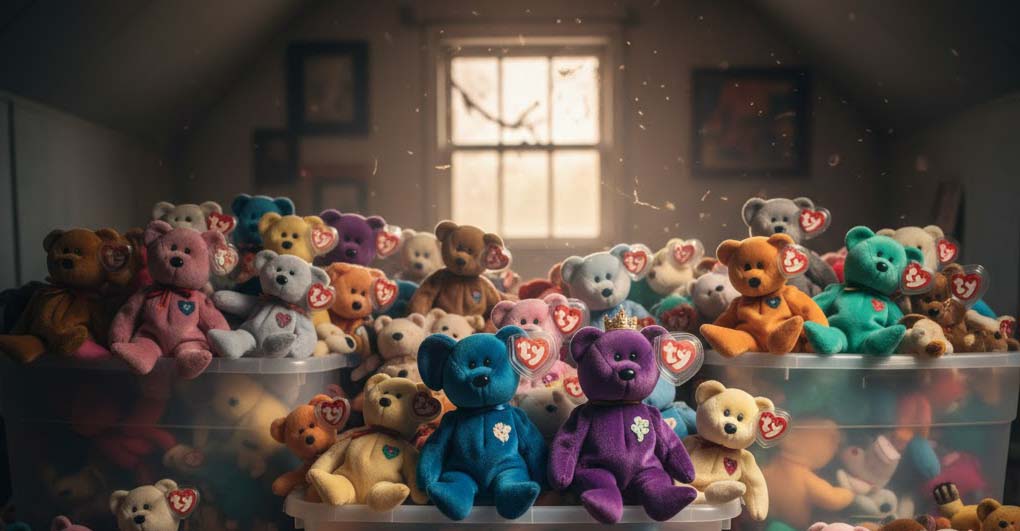
Today, those tubs of Beanie Babies stored in attics and basements are a nostalgic reminder of a uniquely 1990s phenomenon—a perfect storm of clever marketing, emerging technology, and the collective human desire to chase the next big thing.
Comments (0)
No comments yet. Be the first to share your thoughts.
Sign in in your browser to leave a comment.