The Great Virtual Pet Invasion: Remembering the Tamagotchi and Giga Pet Frenzy
It started as a beep. A high-pitched, insistent chirp from a backpack. Then another from a desk. Soon, by the middle of 1997, classrooms, playgrounds, and family dinners were filled with an electronic chorus. This was the sound of the digital pet revolution, a fad led by two pocket-sized titans: Tamagotchi and Giga Pet.
For a brief, intense period in the late 1990s, these simple keychains weren't just toys; they were a responsibility, a status symbol, and, for many parents and teachers, a digital menace. They were the first time an entire generation of children was collectively tasked with keeping a pixelated creature alive.
*The Digital Egg Hatches*
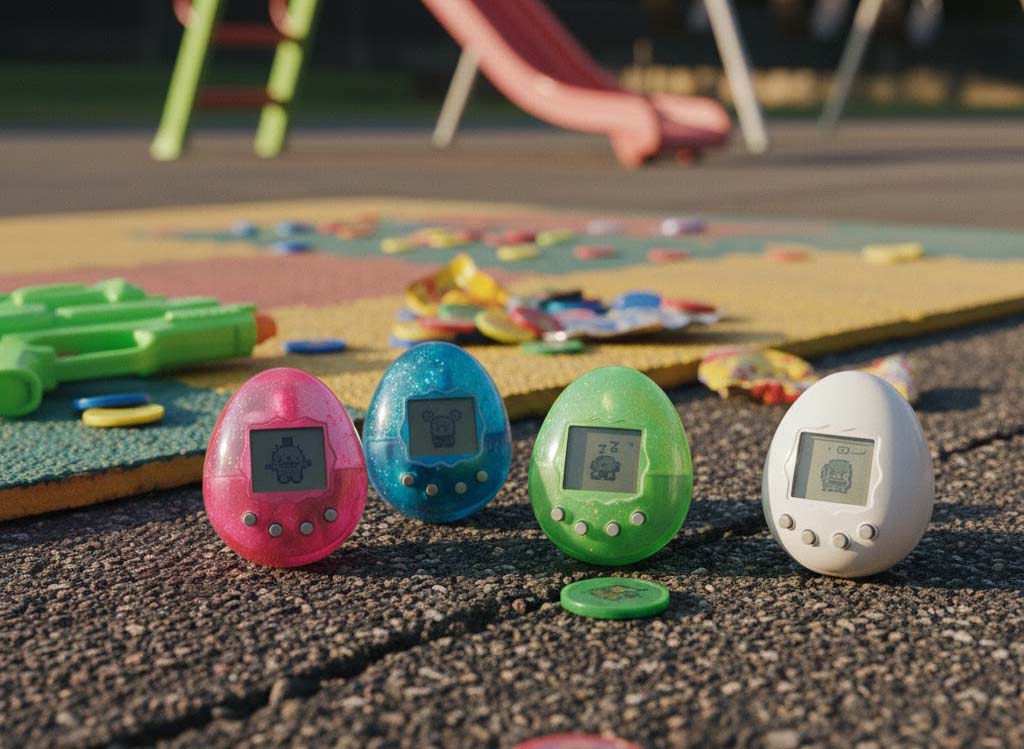
The phenomenon began in Japan in 1996 with the Tamagotchi. Created by Bandai, the name itself translated to "loveable egg." The concept was revolutionary in its simplicity and emotional hook. It was a small, egg-shaped device with a low-resolution LCD screen and three simple buttons.
When activated, a small, pixelated alien creature "hatched." From that moment, it was completely dependent on its owner. The Tamagotchi would beep when it needed:
- Food:* Dropping it a piece of bread or a snack.
- Play:* Engaging in a simple "guess which way I'll turn" game.
- Medicine:* Curing it when it got sick.
- Discipline:* Scolding it for bad behavior (like beeping for no reason).
- Cleaning:* The most infamous task—cleaning up its pixelated poop.
Neglect was not an option. If you failed in your duties, the pet would get sick and, eventually, "die" (often depicted as turning into an angel or a ghost and flying away). This element of virtual mortality was the toy's genius. It created a genuine, if stressful, bond. Kids didn't just play with a Tamagotchi; they raised it.
*The Competitor: Giga Pet Enters the Arena*
Where Bandai had originality, the American company Tiger Electronics had market savvy. Seeing the Tamagotchi’s explosive success, Tiger quickly released its own version: the Giga Pet.
Giga Pets operated on the exact same principle of care and feeding, but they had a key strategic difference. While Tamagotchis were abstract, alien creatures, Giga Pets were familiar. Tiger Electronics secured high-profile licenses, releasing digital versions of:
- 101 Dalmatians:* Timed perfectly with the Disney movie release.
- Popular Animals:* A virtual cat (Compu-Kitty), dog (Digital Doggie), and monkey.
- Franchises:* Later versions included pets based on Babe, The Lost World: Jurassic Park, and even a Star Wars R2-D2.
For many kids, the choice was clear: Why raise a weird alien blob when you could have your very own virtual puppy? A fierce playground debate was born: Were you Team Tamagotchi or Team Giga Pet?
*The Fad in Full Swing*
The demand was unlike anything the toy industry had seen since the Cabbage Patch Kids. Stores were sold out instantly. Shipments would arrive and be gone in an hour. The toys, which retailed for around $15, were being scalped on the black market (or, more accurately, the "playground market") for $50, $75, or even $100.
The constant, needy beeping of the pets quickly became a cultural flashpoint. The toys were a massive disruption.
- School Bans:* Virtually every school in North America banned them. Teachers, driven mad by the incessant chirping, confiscated them by the dozen.
- Playground "Daycares":* This led to a sub-culture of "babysitting," where one kid (often for a fee) would be responsible for looking after all the "pets" of kids who were in class or at recess.
- Parental Obligation:* The phrase "Mom, you have to feed my Tamagotchi!" echoed through homes. Parents found themselves taking the digital pets to work, nervously checking them during meetings to prevent a virtual death and a real-life tantrum later.
*The Inevitable Burnout*
Like all white-hot fads, the virtual pet craze burned out almost as quickly as it began. By 1998, the market was completely saturated. Dozens of imitators like Nano Pets and Dinkie Dino had flooded the shelves, diluting the novelty.
Moreover, the very thing that made the toys a hit—their unrelenting neediness—also became their downfall. The "responsibility" started to feel like a "chore." The stress of keeping the pet alive was replaced by the annoyance of its constant demands.
As 1999 dawned, the next big things—Furby and Pokémon—were already capturing the attention and allowance money of kids everywhere. The beeping faded, and the virtual pets were tossed into junk drawers, their digital ghosts long gone.
*The Pixelated Legacy*
It's easy to dismiss Tamagotchis and Giga Pets as just another 90s fad, filed away with Pogs and slap bracelets. But their impact was surprisingly profound.
These toys were, in many ways, a trial run for the 21st century. They were the first mainstream exposure to:
- Digital Companionship:* The idea of forming an emotional bond with a piece of code.
- "Always-On" Interaction: A device that demanded your attention 24/7, not just when you chose to play with it.
- Push Notifications:* That beep was, in effect, the ancestor of the notifications that rule our lives today.
They were a bizarre, pixelated preview of a future where our digital lives would demand just as much care and feeding as our real ones. For a generation, they were a first, stressful lesson in responsibility—and a sign that the digital world was no longer just on a screen, but in our pockets.
Comments (0)
No comments yet. Be the first to share your thoughts.
Sign in in your browser to leave a comment.